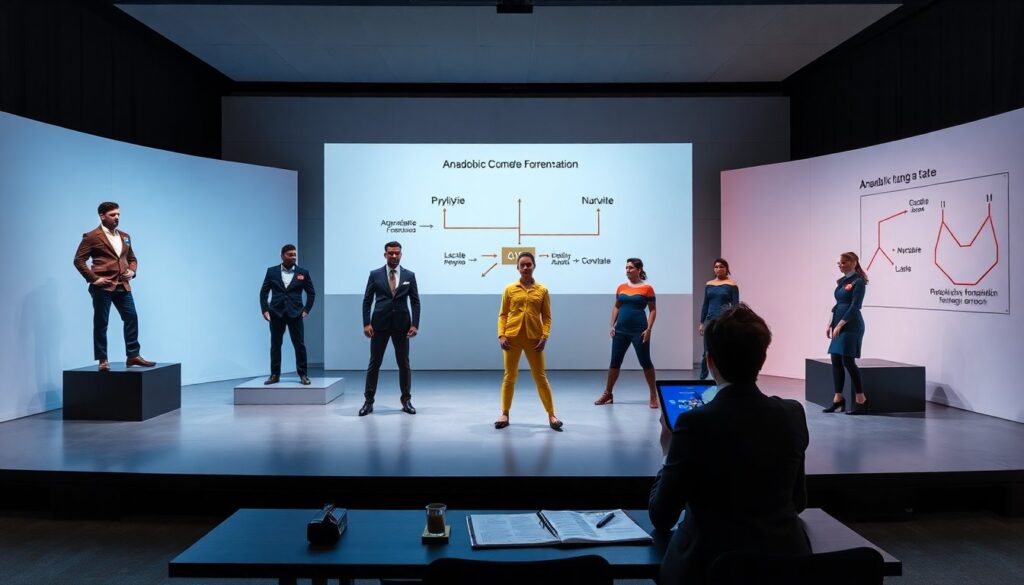
transmrtprject metabolic pathways anaerobic comet play critique opens with a clear scientific claim. The play frames metabolic pathways as dramatic events. The review describes how the production sets scientific facts into character, plot, and image. The review notes where the play explains processes and where it compresses or alters them for stage needs. The review aims to assess accuracy, narrative, metaphor, and production choices.
Key Takeaways
- The play dramatizes metabolic pathways by personifying enzymes and metabolites, making complex anaerobic metabolism accessible and engaging.
- It accurately depicts anaerobic processes like lactate production and ATP yield differences but simplifies regulatory mechanisms for clarity.
- The anaerobic metaphor effectively highlights survival trade-offs but should clarify that these metabolic shifts are reversible adaptations.
- Dramaturgy aligns scientific logic with narrative structure, using pacing and conflict to illustrate metabolic decisions and energy demands.
- Production elements like lighting, sound, and costumes support understanding by visually and sonically representing biochemical states.
- Supplemental materials such as program notes and post-show discussions are recommended to address scientific gaps and deepen audience comprehension.
Scientific Premise And Context: Metabolic Pathways As Dramatic Material
The production presents core metabolic concepts as narrative beats. The dramaturgy assigns roles to enzymes, substrates, and energy carriers. It shows pathways like glycolysis and fermentation as sequences of decisions. The show compresses time and simplifies stoichiometry to maintain pace. The review notes that the play names ATP, NADH, and pyruvate correctly. The play sometimes swaps steps or merges reactions to clarify motive and conflict. The stage choices aid comprehension but they create factual gaps. The review lists those gaps and weighs their impact on scientific literacy.
Accuracy Of Metabolic Pathways Portrayed
The script labels anaerobic and aerobic branches and links them to character choices. The play accurately portrays that anaerobic metabolism yields less ATP than aerobic metabolism. It correctly shows pyruvate converting to lactate in many cases. The show omits key regulatory points such as phosphofructokinase control and allosteric effects. It also simplifies redox balance and proton gradient concepts. The review finds these omissions understandable for audience clarity. The review recommends brief program notes or lobby exhibits to fill specific gaps without slowing the performance.
Dramaturgy And Narrative Structure: How Science Drives The Plot
The narrative uses metabolic states to structure acts and scenes. The first act sets up energy demand and resource scarcity. The second act shifts to adaptation and alternate pathways. The pacing mirrors reaction rates with fast scenes for rapid reactions and slow scenes for buildup. The plot ties personal choices to cellular decisions. The authors use conflict between efficiency and survival to anchor stakes. This structure keeps scientific logic visible and dramatic tension active. The review notes occasional exposition-heavy scenes that slow momentum. Those scenes would benefit from visual shorthand or shorter dialogue.
Characterization Of Scientific Concepts Through Dialogue And Action
The production personifies metabolites as characters who speak and move. Enzymes appear as guides who catalyze change. Dialogue frames reaction steps as choices with consequences. The staging uses costuming and props to mark molecular identity. Actors use movement to show binding and release. This approach clarifies sequences for nonexpert viewers. It also risks implying intent where there is only chemistry. The review observes that the play balances literal and figurative portrayal most of the time. The review suggests occasional program notes to prevent confusion about agency and conscious action.
Themes, Metaphors, And Symbolism: Anaerobic Processes As Cultural Allegory
The production frames anaerobic metabolism as a response to crisis. The metaphor links low oxygen to social constraint. The play treats lactate as both burden and signal. It uses fermentation scenes to show improvisation and survival. The symbolism extends to community choices and moral trade-offs. The review finds the central metaphor resonant and urgent. The metaphor sometimes flattens biochemical nuance into moral good and bad. The review recommends small adjustments to avoid reducing science to moral judgment. Those changes would preserve the metaphor while keeping chemical detail visible.
Effectiveness Of The ‘Anaerobic’ Metaphor For Communicating Complexity
The anaerobic metaphor works to illustrate trade-offs and short-term survival. The metaphor gives audiences an intuitive grasp of why organisms shift pathways. The play uses contrast scenes to show efficiency loss and buildup of byproducts. Those scenes make energetic cost tangible. The metaphor fails when the play implies permanent states rather than reversible shifts. The review advises reinforcing that anaerobic responses can be temporary adaptations. The review also suggests using a short visual chart in the program to map the shifts the play dramatizes.
Production Elements: Direction, Design, And Audience Impact
Direction focuses scenes to highlight chemical logic and human stakes. Lighting and sound mark reaction thresholds and shifts in redox state. Set design reconfigures quickly to represent changing metabolic networks. Music underscores tempo and energy demand. Costumes signal molecular roles with clear motifs. These elements help translate abstract science into sensory experience. Audience response varied. Some viewers left curious about real metabolism. Others sought factual clarification. The review recommends adding post-show talkbacks with a biochemist and a director. Those events would satisfy curiosity and correct misimpressions.